

 Govt. Certified
 6 Month free updates
Your Official Property Records In Minutes
Directly from government databases. Certified, legally valid documents for loans, sales, disputes, and more.


Where property records are used
Official land records prove ownership and legal rights. Essential for loans, property sales, resolving disputes, and protecting your investment.

Personal Record Keeping
Maintain a verified record of your ownership—essential for succession, mutation, and long-term clarity.

Bank Loans & Mortgages
Lenders use property records to verify ownership, assess liabilities, and approve loans or mortgages.

Legal Proceedings
Certified records serve as legal proof in ownership disputes, boundary issues, and encroachment cases.

Buying or Selling Property
Buyers verify ownership and check for liabilities. Sellers use them to establish clear, marketable title.

Mutation & Name Transfer
Required to update ownership in government records after purchase or inheritance.

NRI Property Management
Access and monitor your property records from anywhere—without needing to visit in person.
How It Works
Property documents in 3 easy steps
Without visiting any government office or going to lawyers.
 1
1Select Your Documents
Select your property state and the documents you want delivered.
 2
2Enter Property Details
Provide details or simply upload any existing property document.
3Download Your Records
Receive your certified property documents within minutes.

6 months free updates included with every order
Property records change after mutations, new ownership entries, or encumbrance updates. Come back anytime within 6 months and re-download the latest version at no extra charge.
 Re-download after any mutationAlways get the latest recordNo re-payment for 6 months
Get property records
Property State
 Gujarat
Select documents you need
Where property records are used
Official land records prove ownership and legal rights. Essential for loans, property sales, resolving disputes, and protecting your investment.
Personal Record Keeping
Maintain a verified record of your ownership—essential for succession, mutation, and long-term clarity.
Bank Loans & Mortgages
Lenders use property records to verify ownership, assess liabilities, and approve loans or mortgages.
Legal Proceedings
Certified records serve as legal proof in ownership disputes, boundary issues, and encroachment cases.
Buying or Selling Property
Buyers verify ownership and check for liabilities. Sellers use them to establish clear, marketable title.
Mutation & Name Transfer
Required to update ownership in government records after purchase or inheritance.
NRI Property Management
Access and monitor your property records from anywhere—without needing to visit in person.

Know what are property records in Gujarat
A complete guide to every type of property document in Gujarat.
This guide helps you understand exactly what each record means, what details are in each document, and where they are used for proving ownership, buying, selling, or applying for a loan.
7/12 Extract (Satbara Utara)
Rural land ownership and usage.
Property Type: Rural — Village / outside city limits
What is 7/12 extract?
7/12 is the most fundamental Record of Right (RoR) for rural properties in Gujarat. The name comes from two government forms combined — Village Form 7 (Who owns the land and their rights) and Village Form 12 (How the land is currently used). It applies to any rural land — not just farmland — and is the starting point for almost any transaction involving land outside city limits.
What details are in 7/12 extract?
Current owner's name, precise survey number, total area or extent, and any active bank / other loans or government restrictions (like "New Tenure").
- Legal owner(s) of the land
- Land classification and total area
- Current land use
- If there are loans or liabilities on the land
- Government restrictions
- Tenure restrictions
Used for
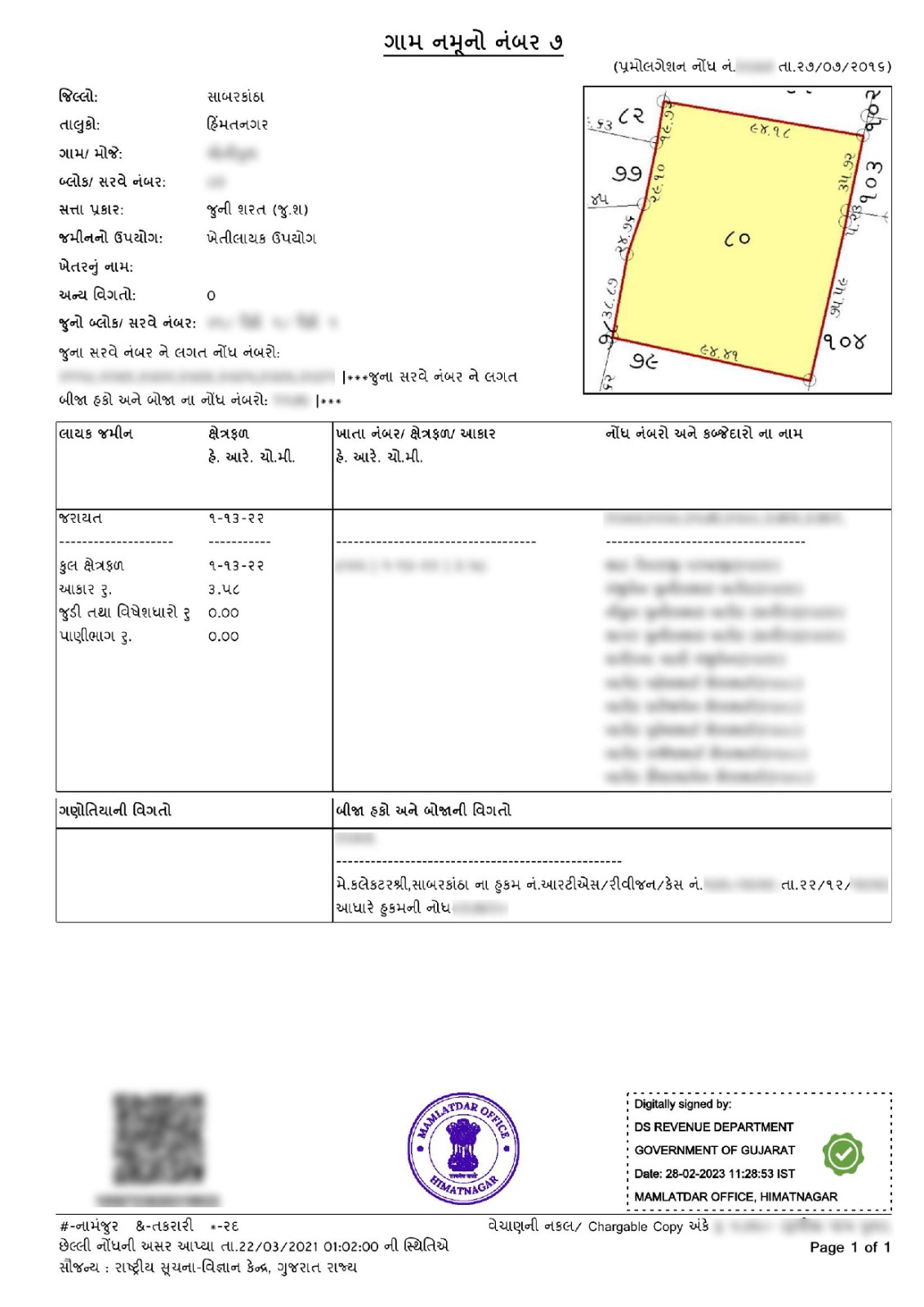
7/12 Extract (Satbara)
ગામ નમૂના ૭/૧૨ (સાત-બાર)
8A Utara (Khata)
Total village landholding per owner.
Property Type: Rural — Village / outside city limits
What is 8A Utara?
8A is a summary of all land (survey numbers) held by one person in a single village. While 7/12 tells you about a specific survey number, 8A tells you about the person/s owning every survey number in that village. Think of it like a land holdings statement, similar to a bank statement listing all your accounts.
What details are in 8A Utara?
Every survey number owned by person/s in a village — their complete landholding record, Khata number, and individual as well as combined area.
- All survey numbers owned by person/s in that village
- Individual and total combined land area
- Khata (account) number assigned by the revenue department
- Land category for each survey number
- Village-specific record only — other villages require a separate 8A
Used for
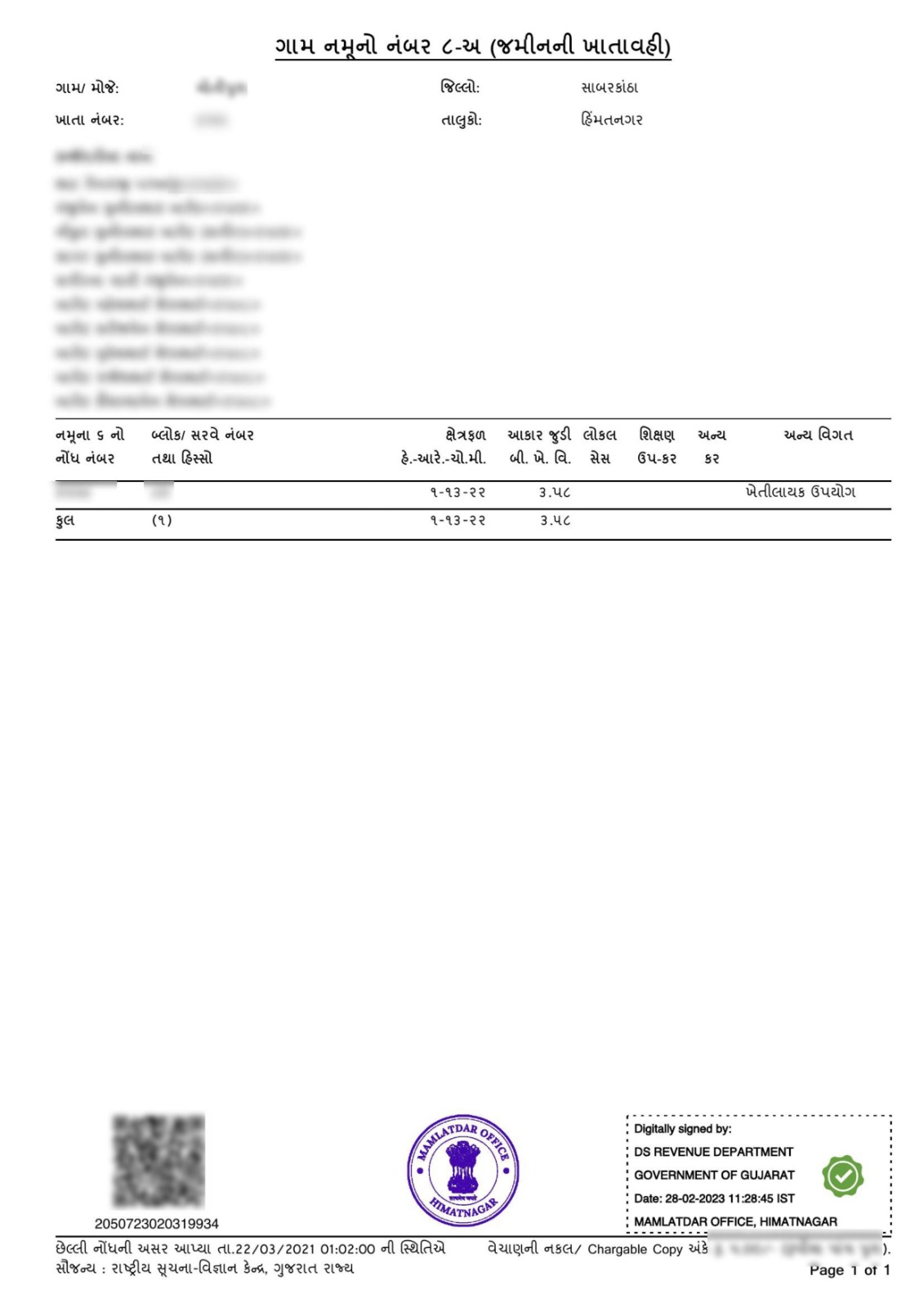
8A Utara (Khata)
ગામ નમૂના નં. ૮-અ (ખાતા)
Old Ferfar 6A (Historical Mutation Records)
Archive of past ownership / transaction history.
Property Type: Rural — Village / outside city limits
What is Old Ferfar 6A?
These are archived records of every past ownership change and other transactions — going back 30, 50, or even 70 years. Often handwritten in old Gujarati or Marathi script, they trace how land has passed through generations. They are the ancestral roots of a property and are essential for establishing a clean chain of title.
What details are in Old Ferfar 6A?
The complete history of how a piece of land has changed hands over decades — family divisions, old sales, and any historical restrictions still attached, including the rights of people whose names don't directly reflect in the latest 7/12.
- Complete historical chain of ownership
- How land was divided among past family members
- All old survey number changes
- Old government or New Tenure restrictions
- Records of transactions going back up to 70 years
Used for
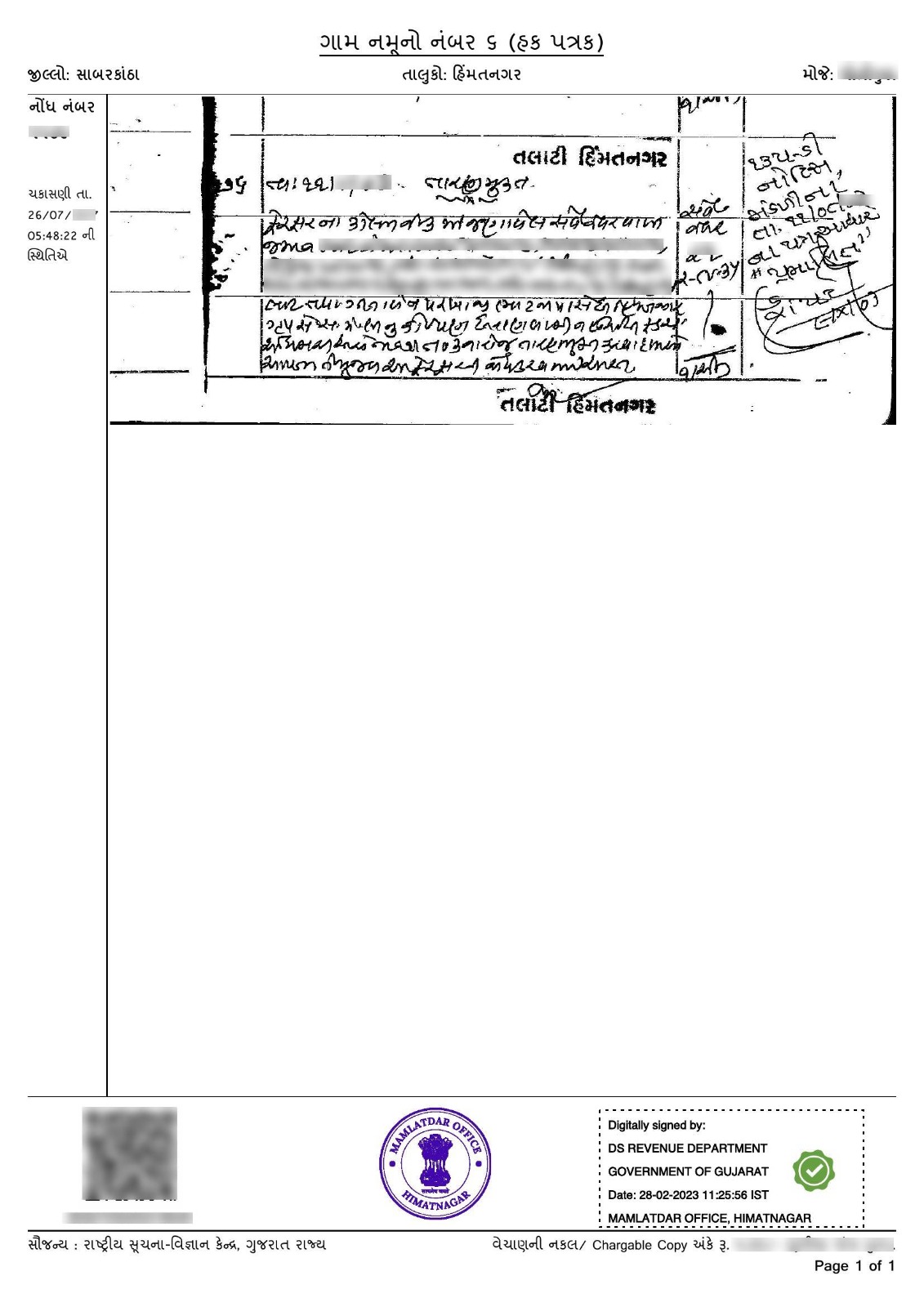
Old Ferfar 6A
જૂના ફેરફાર ૬-અ
VF-6 Entry (HakPatrak / Nondh Ferfar 6A)
Record of transactions executed for a given survey number.
Property Type: Rural — Village / outside city limits
What is VF-6 Entry (Nondh / Ferfar 6A)?
Ferfar means change. Every time land changes hands — through a sale, gift, inheritance, or court order — the Talati (Village Revenue Officer) records it as a Ferfar entry. Ferfar entry is also entered for other transactions such as promulgation, transferring land from Rural to Urban, revenue/court cases, outstanding annual revenue tax, converting land from Agri to Non-Agri, etc. The current Ferfar 6A is the most recent such entry and comes with an approved or rejected status from the Government.
What details are in VF-6 Entry?
The specific records of the most recent ownership transfer — who gave, to whom, why, and whether it has been officially approved, along with other transaction status mentioning all parties involved.
- Entry number and date of change
- Reason for transfer (sale, gift, inheritance, or court partition)
- Previous owner's name
- New owner's name
- Survey number involved in the change
- Whether the entry is approved or still pending
Used for
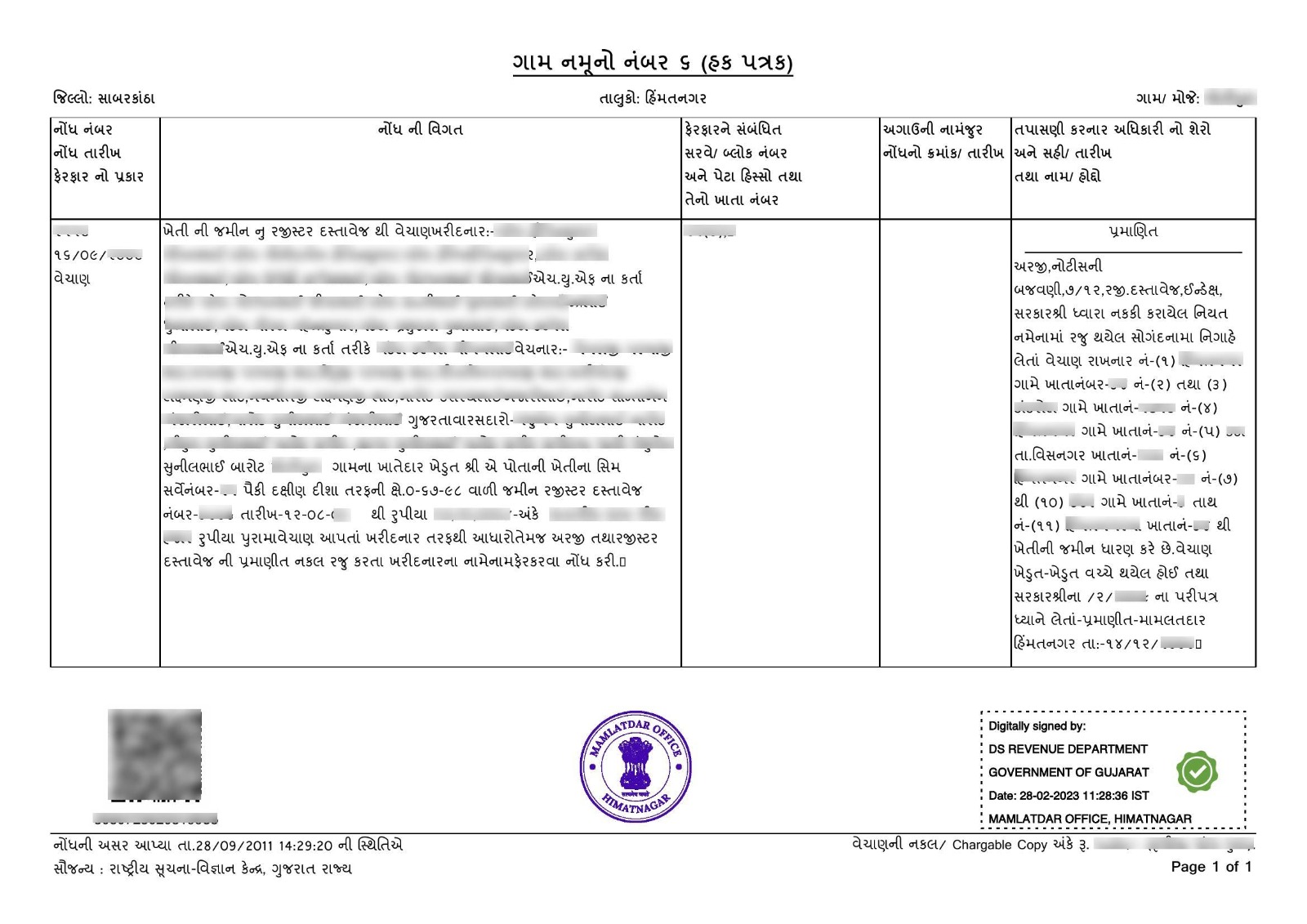
VF-6 Entry (HakPatrak)
ગામ નમૂના ૬-અ (હ.પ.)
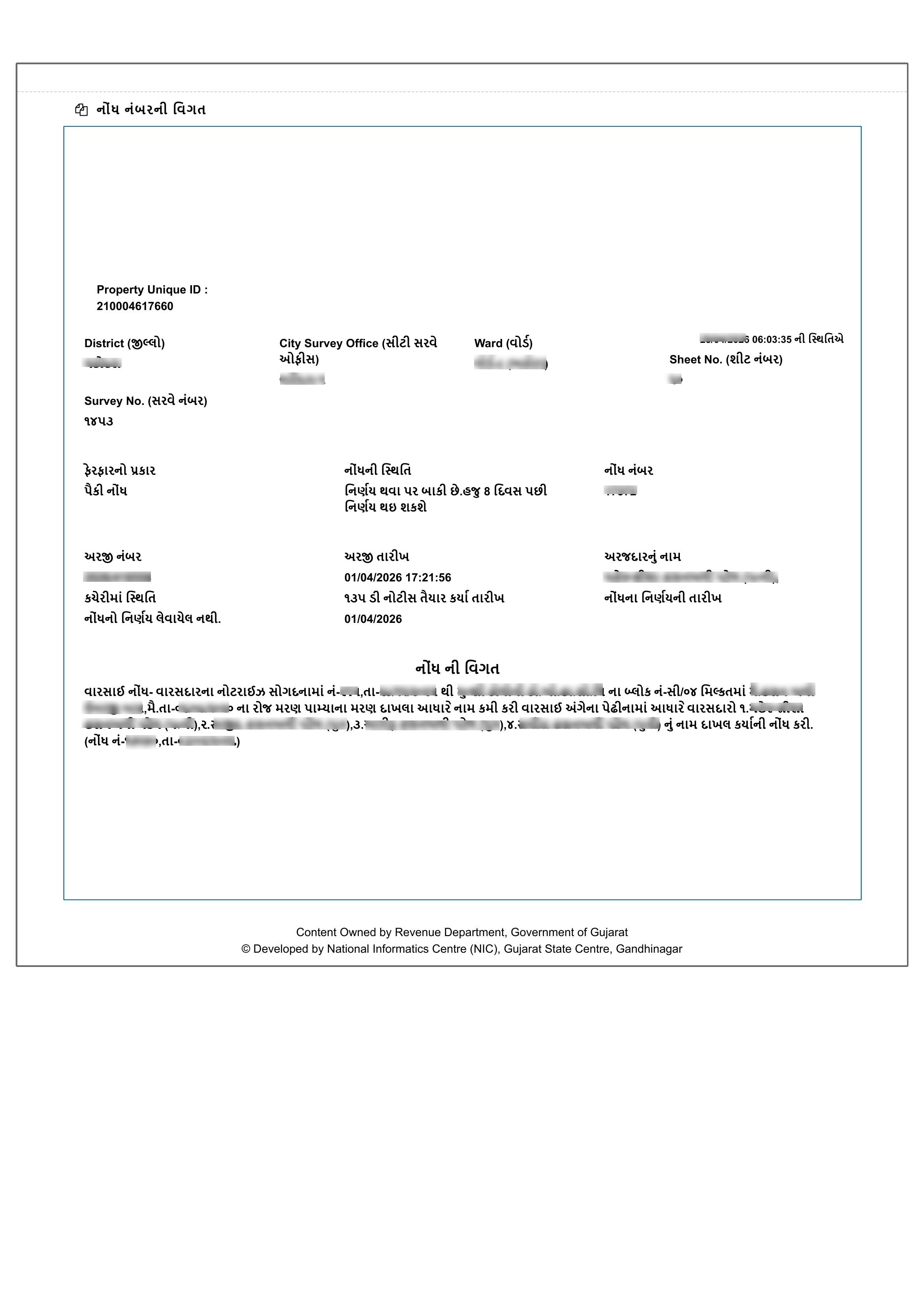
Property Card Mutation (City Survey Name Transfer)
Urban ownership name update record and other transaction records.
Property Type: Urban — City / municipal area
What is Property Card Mutation?
After buying an urban property and registering the Sale Deed, the City Survey Office still has the old owner's name on their records. Mutation is the formal process of replacing that name with the new buyer's name. Until mutation is done, the city survey records do not officially recognise the new buyer as the owner for any official purpose. It also captures other transactions that happen on the urban property.
What details are in Property Card Mutation?
The official city record confirming the name change — the City Survey Office has updated its register to reflect the new owner.
- New owner's name
- Mutation entry number and date
- Old owner's name
- Reference to the Sale Deed used for the transfer
- Transaction amount and extent
Used for
Property Card Mutation
સ્થ. મિ. હ.ફ. (નગર સર્વે)
Property Card (City Survey Record)
Urban property identity record.
Property Type: Urban — City / municipal area
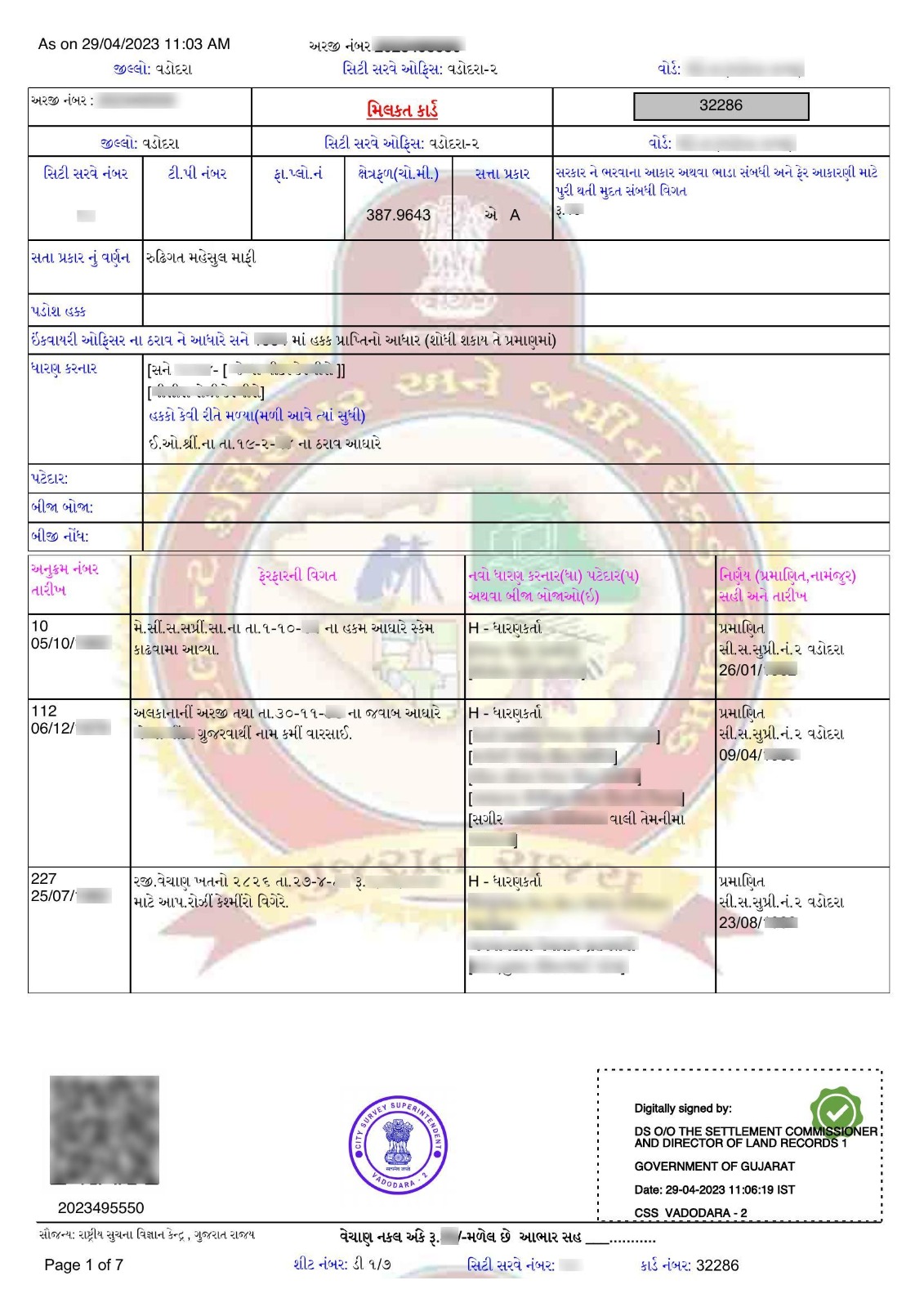
What is Property Card?
The Property Card is the urban equivalent of 7/12. Once land is within a city or town's municipal boundary, agricultural records no longer apply — the City Survey Office takes over. The Property Card is the primary ownership record for any urban property — whether it is a plot, flat, or bungalow.
What details are in Property Card?
City Survey Number, owner name, plot dimensions, and any built area — the core identity record for properties inside city limits.
- City Survey Number (CSN) and ward
- Owner's name
- Plot area and constructed area
- Property boundaries
- History of previous owners
- Mutation entries from the time property card comes into existence
Used for
Property Card
સ્થાવર મિલ્કત કાર્ડ
Index 2 (Sub-Registrar's Registration Extract)
Official summary of registered sales deed.
Property Type: Urban & Rural — Applies to both
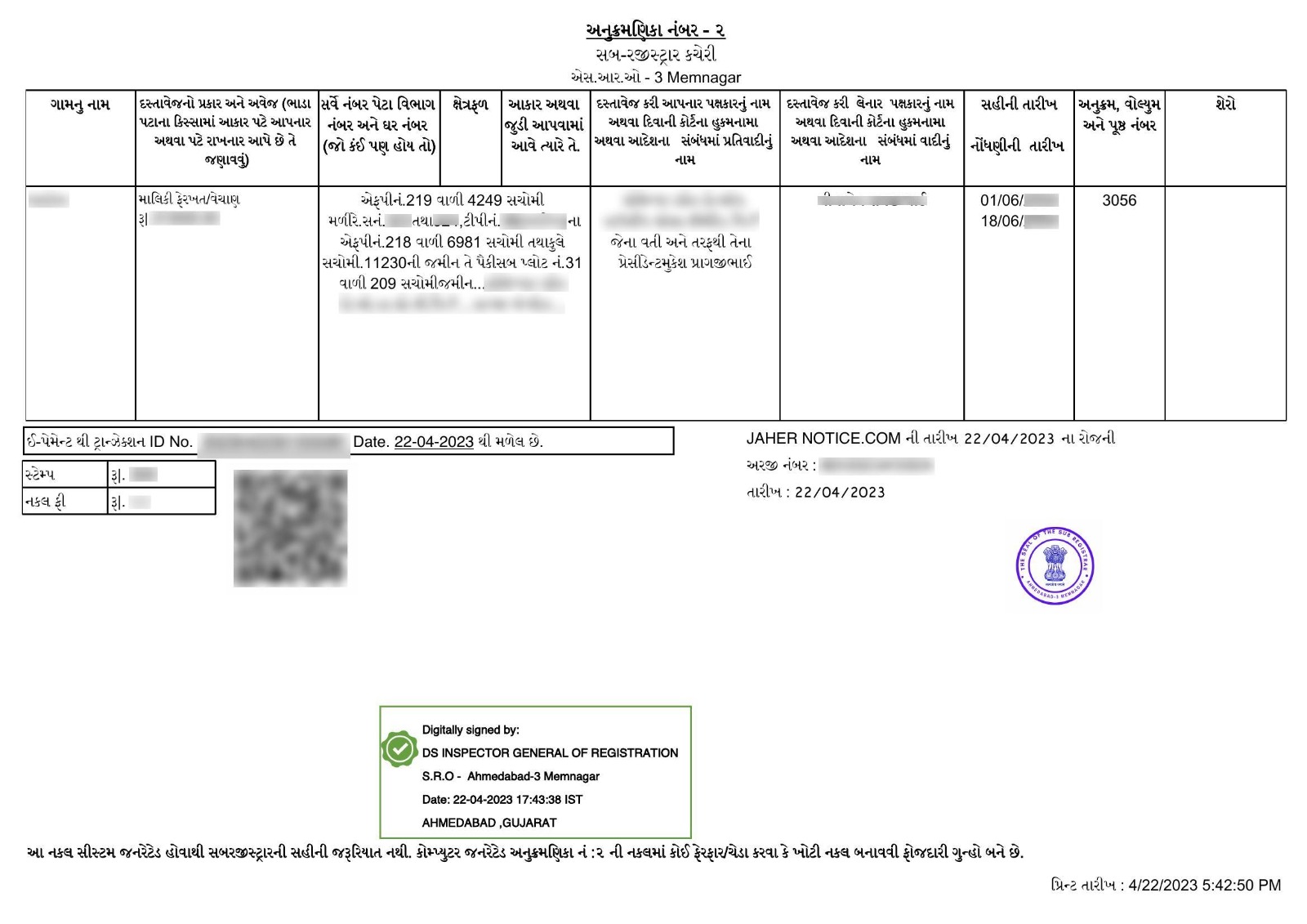
What is Index 2?
When a property deal or transaction is registered at the Sub-Registrar's office, Index 2 is the government's official public extract confirming the details of that transaction. A privately notarized agreement is not the same — Index 2 is legally far stronger because it proves the deal entered in the official government records.
What details are in Index 2?
The key facts of a registered property transaction — who bought, who sold, what was paid, and the stamp duty amount officially deposited with the Government.
- Type of transaction
- Buyer and seller names
- Property description
- Date of registration
- Transaction value (price paid)
- Stamp duty amount paid
- Document registration number
Used for
Index 2
ઇન્ડેક્સ-૨
Encumbrance Certificate (EC)
Proof of any outstanding encumbrance on a land/property.
Property Type: Urban & Rural — Applies to both
What is Encumbrance Certificate?
An EC is a search of all registered financial and legal transactions on a property over a defined time period — typically 13 to 30 years, or even before that. If a previous owner had an unpaid loan on the property and you buy without checking, the bank or lender can legally recover from you in case of default. The EC tells you whether anyone else has a financial claim on what you are about to buy.
What details are in Encumbrance Certificate?
A period-specific list of every registered transaction on the property — mortgages, court orders, liens, and all sale or transfer deeds, issue and cancellation of Power of Attorney, etc.
- All registered mortgages and loans
- Court orders and legal notices
- All registered sale and gift deeds
- Issue and cancellation of Power of Attorney
- Any liens or charges on the property
- Whether the property is clear or encumbered
Used for
Encumbrance Certificate
ભારણ પ્રમાણ-પત્ર (EC)
Certified Sale Deed (Dastavej)
Core legal contract of ownership.
Property Type: Urban & Rural — Applies to both
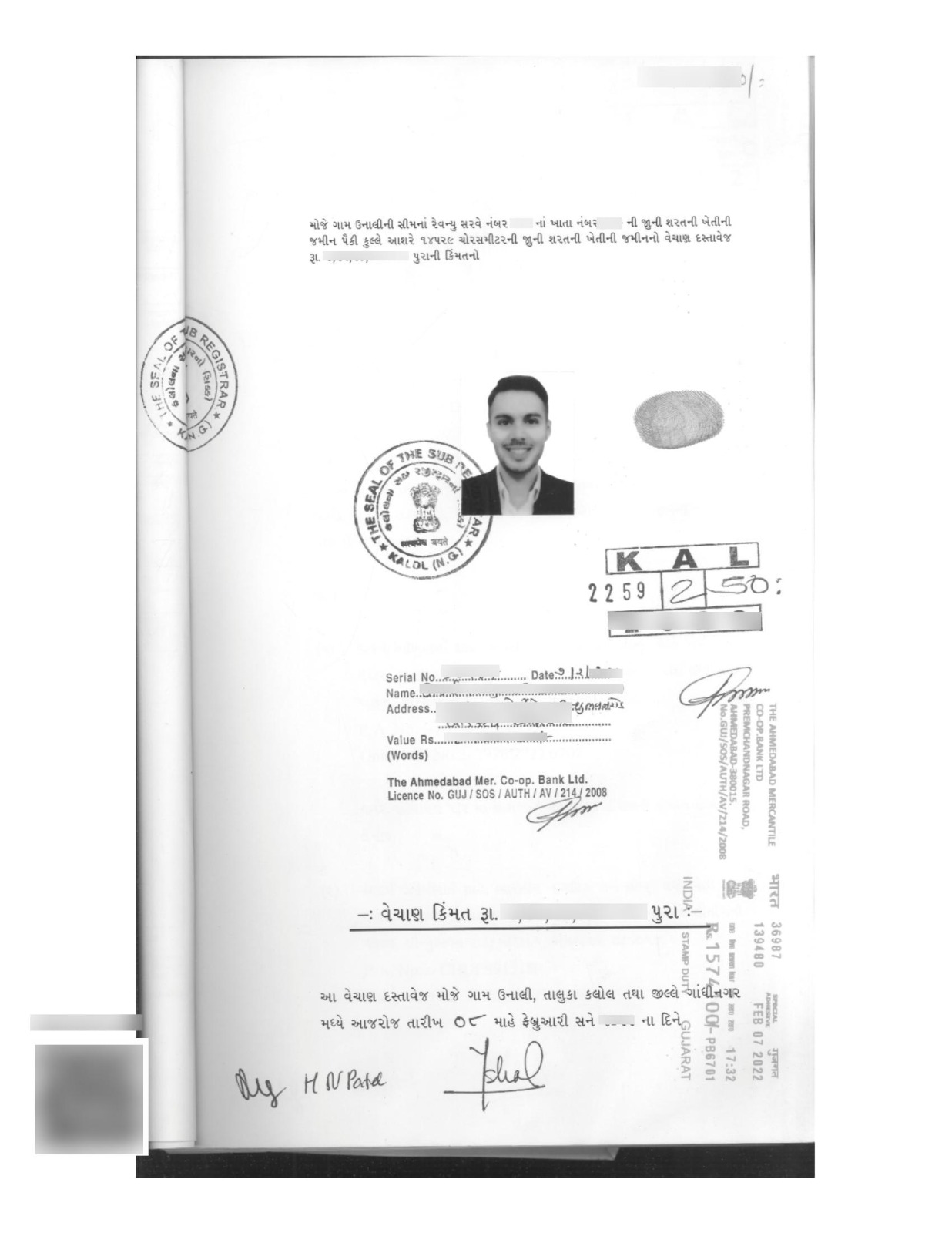
What is Certified Sale Deed?
The Sale Deed is the actual legal agreement signed and registered at the Sub-Registrar's Office when a property transaction happens. At 30 to 50 pages, it is the most authoritative proof of ownership that exists. Courts treat it as the definitive evidence of a property transfer and ownership confirmation.
What details are in Certified Sale Deed?
The complete terms of the sale — every detail of what was agreed, by whom, for how much, with full property boundaries, official signatures, and supporting KYC documents of buyer/s and seller/s.
- Full buyer and seller details
- Complete property description with boundaries
- Exact price paid
- All terms and conditions of the sale
- Signatures of both parties and their witnesses
- Sub-Registrar's official seal with document number and year
Used for
Certified Sale Deed
સ-નકલ વેચાણ-દસ્તાવેજ
F Form (Town Planning Final Plot Record)
Town planning plot allotment record.
Property Type: Urban — City / municipal area
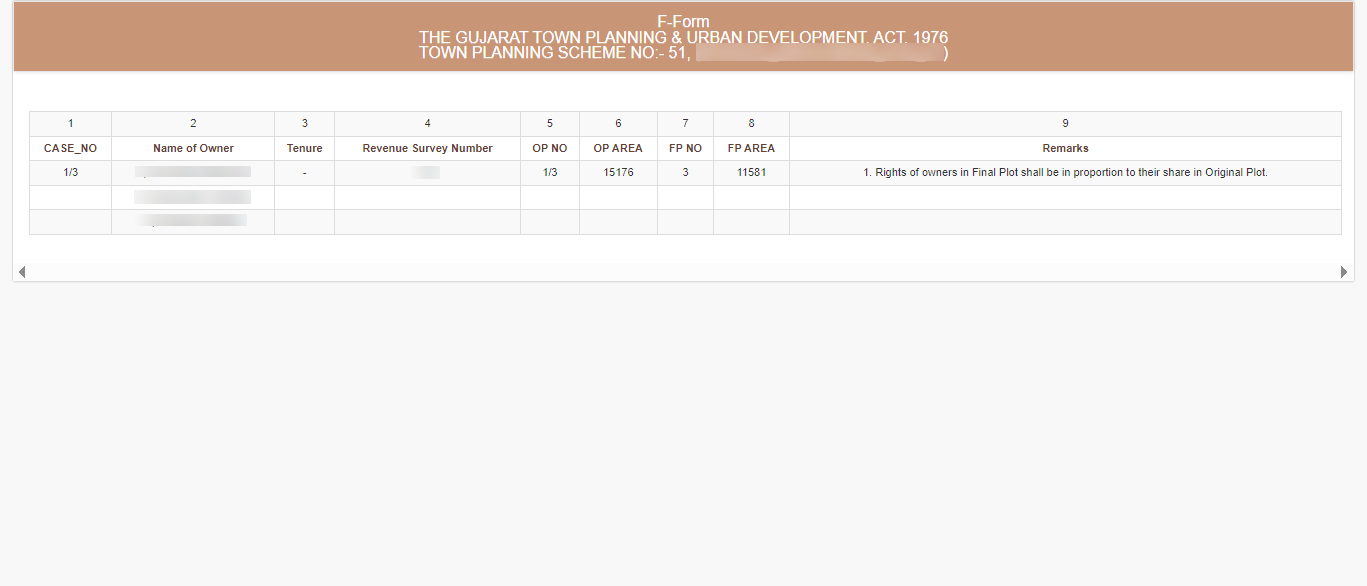
What is F Form?
When the government develops new urban areas through a Town Planning (TP) Scheme, it rearranges land and takes a portion for roads, parks, and other public infrastructure. The F Form shows what you originally owned and what you legally own after the government deductions. Without it, your actual plot size cannot be officially confirmed.
What details are in F Form?
Your original plot and your final allocated plot — the government's rearrangement of land in a new township, including any charges owed.
- Original plot number and area with owner's name/s
- Final Plot (FP) number and area after deductions
- Area taken by government for public use
- Betterment charges owed to the government
- Revised plot boundaries
Used for
F Form (TP Scheme)
ટ.પ. F ફોર્મ
135-D Notice (Mutation Public Notice)
Legal notice inviting objections to a mutation.
Property Type: Rural — Village / outside city limits
What is 135-D Notice?
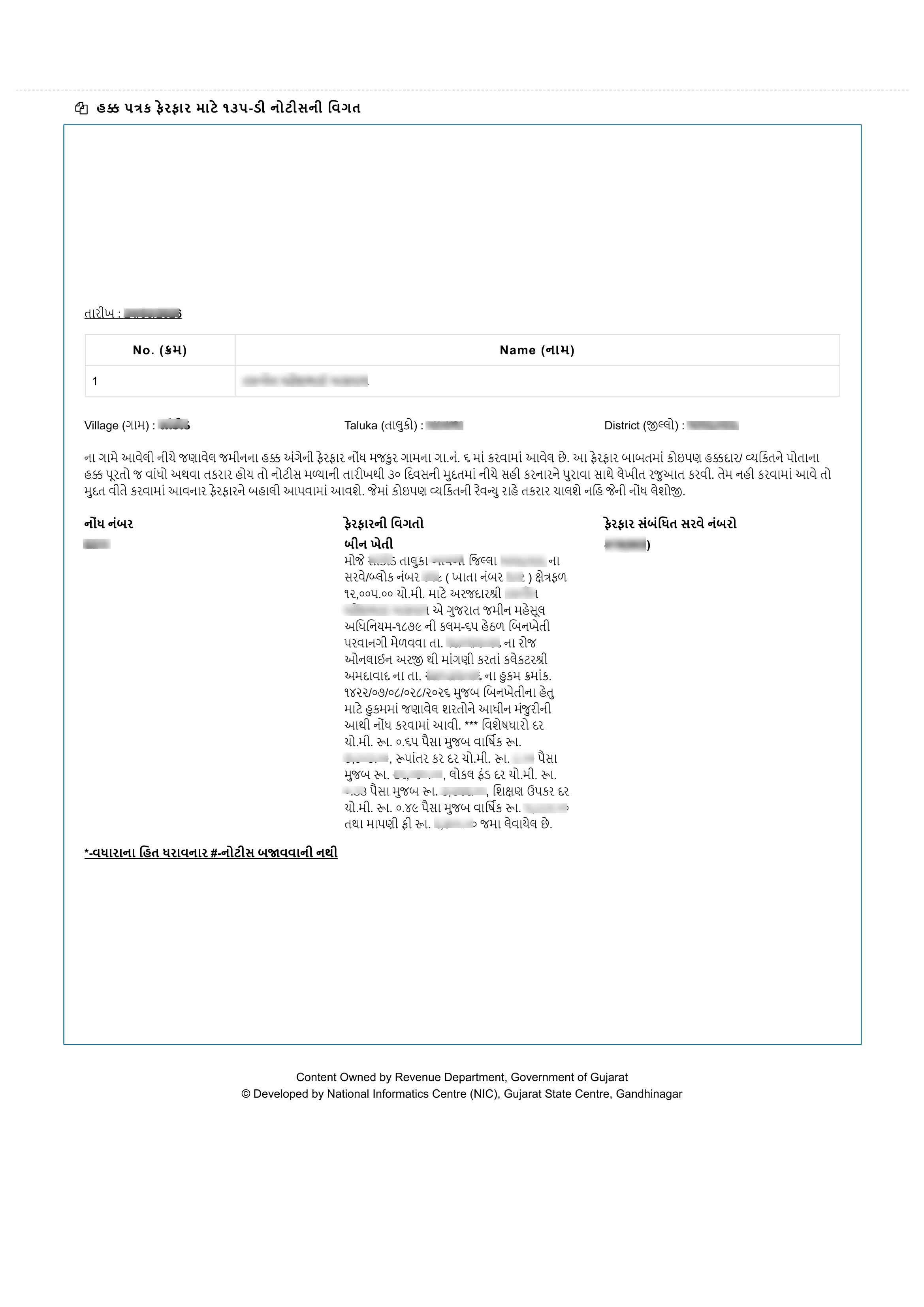
The 135-D Notice is a mandatory public announcement issued by the Talati when a property ownership change is filed or other transactions are initiated for a property. It gives all eligible owners of a land/property, and other right holders such as Banks/Financial Institutions, a time period of 30 days to raise a legal objection, if any. The name change on records is not final until this notice period expires without a challenge.
What details are in 135-D Notice?
The legal public record of an ownership change — who is transferring, to whom, and the deadline by which anyone may object, and for other transactions initiated, e.g. court cases.
- Current owner's name and incoming owner's name
- Reason for the transfer
- Date the notice was issued
- Deadline for filing objections
- Talati's official signature
Used for
135-D Notice
૧૩૫-ડ નોટિસ
Part-Plan (Plot Boundary Map)
Detailed layout of specific plot allocated as part of new TP scheme.
Property Type: Urban — City / municipal area
What is Part-Plan?
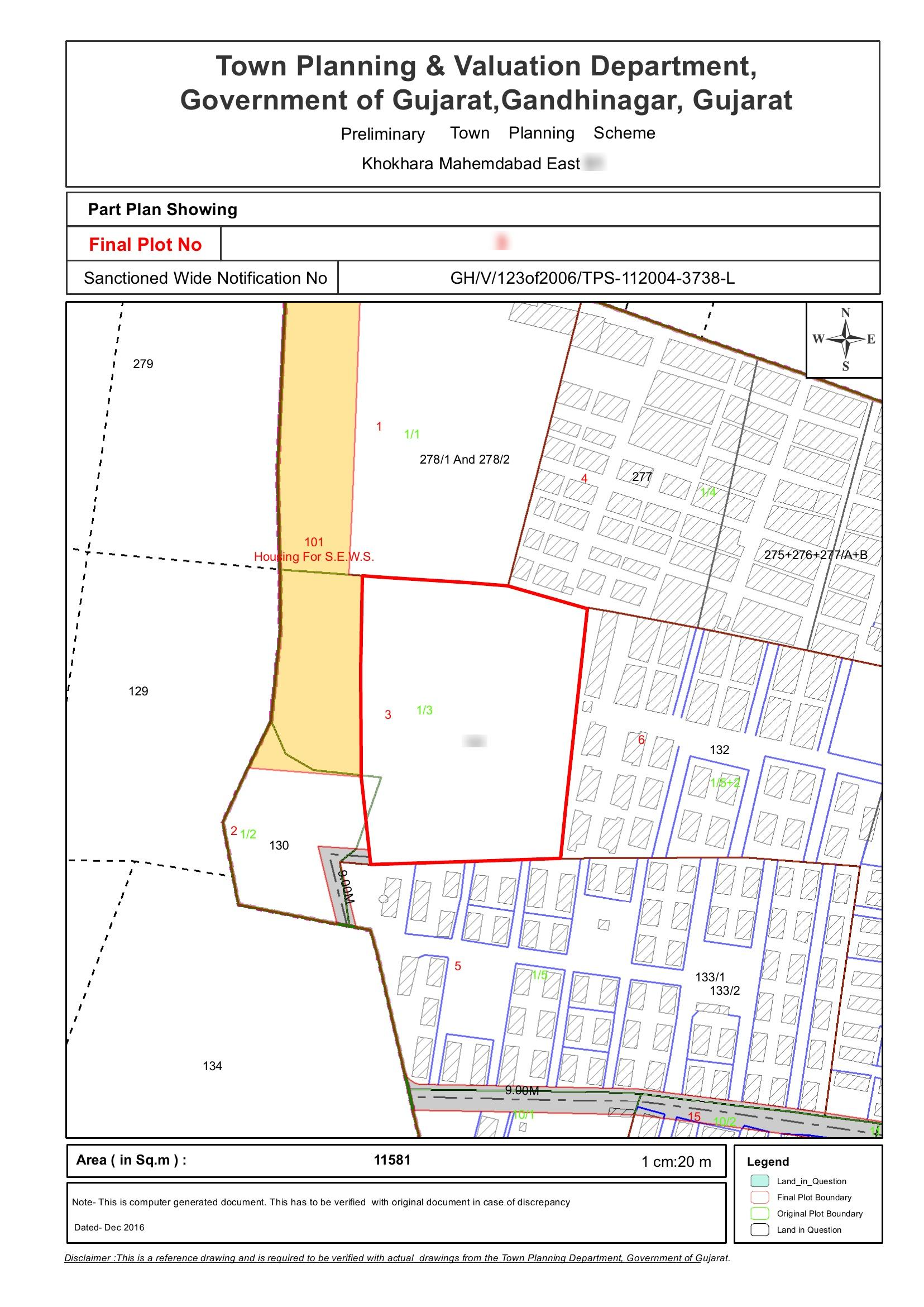
A Part-Plan is a detailed zoomed-in map of your specific land parcel, extracted from the larger city survey map or Town Planning map. It shows the exact shape and physical dimensions of your plot — the document that confirms what is on paper actually matches the land on the ground.
What details are in Part-Plan?
The precise physical boundaries of your plot — dimensions, orientation, adjacent roads, and neighbouring plot numbers.
- Exact plot dimensions and area
- Shape and orientation of the plot
- Adjacent roads and their widths
- Neighbouring plot and survey numbers
- Scale measurement reference
Used for
Part-Plan
ભૂ-ભાગ-નક્શો
Not sure which documents you need?
For most purchases in Gujarat, start with a 7/12 or Property Card, Mutation Entries and an Encumbrance Certificate. If a bank loan is involved, you will also need a Title Search Report. Scroll up to enter your property details.